

What Are Toroids, and How Do You Choose the Right One?
Specify Toroids by Application, Not Shape
A toroid is easy to recognize by its ring shape, but it should not be purchased by shape alone. Only the outside diameter, inside diameter, height, and price describe the form. Those measurements do not prove correct behavior under current, frequency, temperature, winding stress, or assembly limits.
For an engineer or technical buyer, the safer question is not simply, “What size toroid do I need?” The better question is, “What job must this toroid perform inside the finished product?” This shift matters because two same-size toroids often behave differently when the material, winding method, insulation system, test condition, or thermal environment changes.
Torelco works in that practical space between magnetic design and buildable custom components. A quote-ready toroid requirement should define the application, magnetic material, winding construction, electrical target, mechanical fit, lead routing, quantity, and acceptance criteria before the buyer compares price.
What a Toroid Is
A toroid is a ring-shaped magnetic component designed to carry magnetic flux around a closed circular path. That closed path is why toroids are often selected for compact transformers, inductors, chokes, current sensors, and EMI suppression parts. Compared with many open magnetic geometries, a toroidal shape can support efficient use of core material, strong magnetic coupling, and lower stray magnetic fields.
The same closed shape also creates manufacturing limits. Wire must pass through the center window during winding. This affects how many turns fit, winding density, insulation handling, and lead exit location. A toroid might look correct in a drawing and still create problems when the finished wound component exceeds the available package space or routes leads into nearby parts.
This is why buyers should separate the bare core from the finished component. A toroidal core is the unwound ring. A wound toroid includes the core, wire, turns, insulation, terminations, lead orientation, and finished dimensions. A toroidal transformer, inductor, current sensor, or EMI component may look similar at first glance, but each requires different electrical and mechanical details.
Material Choice Sets the First Boundary
Material choice controls much of the toroid’s practical behavior. Ferrite toroids often support high-frequency performance, EMI impedance, and low eddy-current loss, but ferrite grades vary by permeability, loss behavior, and saturation response. Powdered iron toroids often suit energy-storage inductor applications because the distributed air gap can accommodate DC bias, but the correct choice still depends on waveform, frequency, current, and heat.
Other magnetic materials can serve different roles. Steel, amorphous, and nanocrystalline-style cores meet some requirements for high flux density, current-sensing performance, common-mode impedance, or higher-efficiency power conversion. Each choice brings tradeoffs around cost, saturation, handling, insulation, and frequency response.
For sourcing, “toroid” is only the geometry. The purchasable requirement is the combination of geometry, material behavior, winding construction, electrical rating, thermal limit, and documented test condition. A ferrite EMI toroid, a powdered-iron inductor core, and a high-performance common-mode core often share similar dimensions and still make poor substitutes for one another.
Start with the Toroid’s Job
The application sets the priority. A toroidal transformer needs attention to voltage ratio, frequency, insulation, thermal rise, and winding layout. A toroidal inductor needs attention to inductance, current rating, saturation margin, core loss, copper loss, and temperature rise. An EMI toroid needs the right impedance profile across the problem frequency range, not merely a convenient ring size.
A clear function statement also helps the supplier identify what should be confirmed before quoting or production. If the function is vague, the supplier must make assumptions about material, winding, insulation, test conditions, and acceptance criteria. Those assumptions make quotes look comparable while hiding major differences in performance or labor.
Application |
What to Define First |
Main Risk if Underdefined |
Transformer |
Voltage ratio, frequency, power, insulation, winding layout, thermal limits |
Wrong voltage behavior, heat, poor regulation, or spacing concerns |
Inductor |
Inductance, current, saturation margin, core loss, copper loss, temperature rise |
Saturation, reduced inductance, overheating, or efficiency loss |
EMI suppression |
Impedance profile, frequency range, material grade, current handling, placement |
Noise remains because the material misses the problem band |
Common-mode choke |
Common-mode impedance, winding balance, current, insulation, leakage effects |
Weak suppression or unwanted circuit interaction |
Current sensing |
Linearity, saturation behavior, frequency range, turns, burden, accuracy |
Measurement error, distortion, or drift |
Define the Magnetic and Electrical Limits
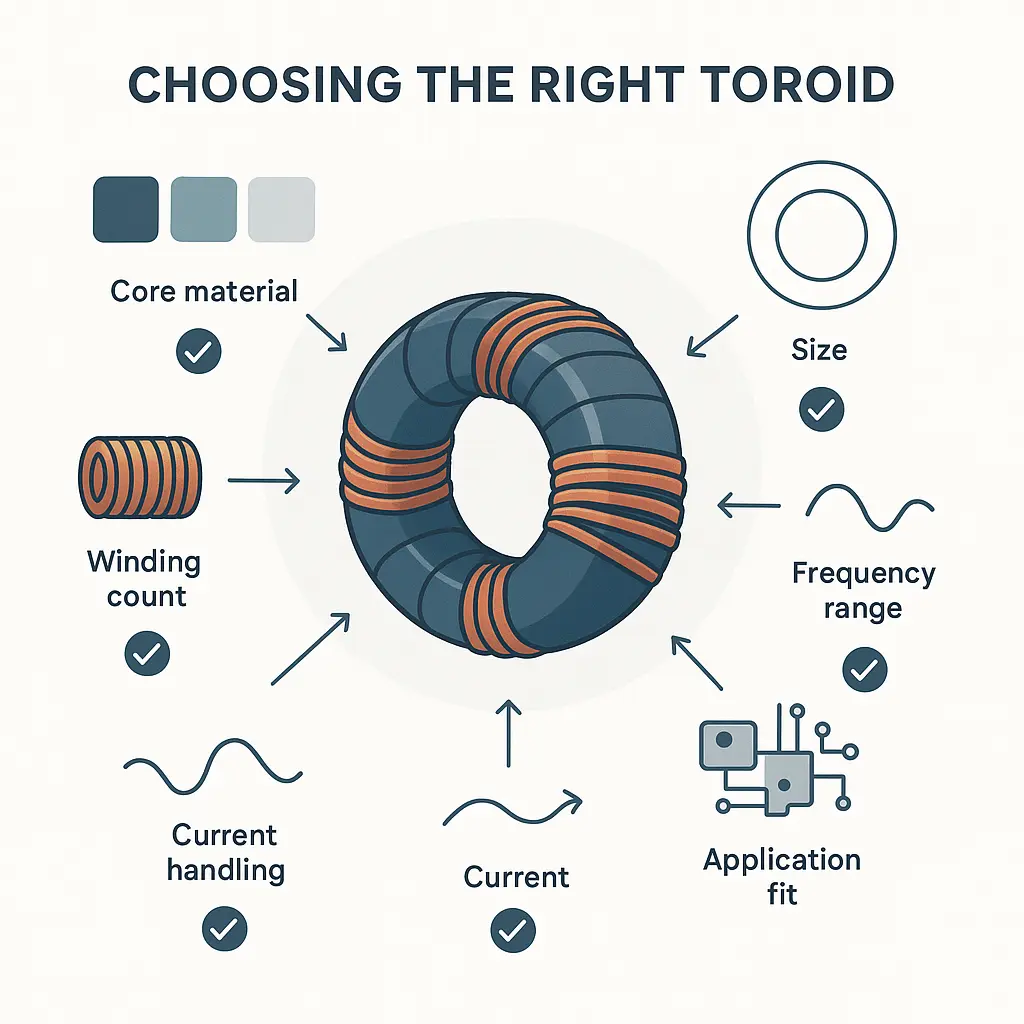
A toroid must work under the real electrical conditions of the product. That means the specification should include the operating frequency, current level, peak conditions, saturation expectations, target inductance or impedance, resistance limits, and test method. A value measured at the wrong frequency, current, or temperature misleads both the buyer and the supplier.
This is where same-size substitutions become risky. A replacement might match outside diameter and height, yet fail under DC bias, heat, frequency, or waveform conditions. The buyer should confirm the magnetic behavior and the test conditions before approving a substitute or comparing suppliers.
Before sourcing or approving a replacement, confirm these items rather than relying on dimensions alone:
- Material grade or required magnetic behavior, including permeability, loss behavior, and saturation response.
- Operating frequency, test frequency, waveform assumptions, and the noise band or switching range involved.
- Continuous current, peak current, duty cycle, DC bias, and expected worst-case load.
- Inductance or impedance target, tolerance, temperature condition, and bias condition.
- Resistance limit, copper loss, core loss, and any expected temperature-rise limit.
- Supplier test method, measurement conditions, substitution limits, and available data sheets.
Check Winding and Mechanical Fit Early
A toroid might pass the electrical screen and still fail in the assembly. The winding window limits how much wire can pass through the core and how much buildup the finished part can tolerate. A dense winding might solve space or electrical goals, but it reduces process margin and makes lead routing, insulation, or repeatability more difficult.
Lead exit location is often where a theoretical selection becomes a practical problem. If the leads exit from the wrong side, the part might interfere with a mounting point, an enclosure wall, an adjacent component, or a connector path. Termination style also matters because stripping, tinning, sleeving, connectors, and strain relief change labor, inspection scope, and finished size.
A useful toroid specification should answer the mechanical questions that affect buildability and fit:
- What are the maximum finished outside diameter, height, and window-clearance limits?
- How many turns are required, and what wire gauge or construction is expected?
- Where should leads exit, how long should they be, and how should they be prepared?
- What insulation system, sleeving, spacing, or voltage requirement applies?
- How will the toroid mount inside the finished assembly?
- Does the design need prototype flexibility, production repeatability, or both?
Separate Core Selection from Finished Toroid Requirements
A bare toroidal core and a finished wound toroid create different buying risks. A core-only request is often evaluated based on material, dimensions, permeability, losses, saturation, and frequency range. A wound toroid request requires the same details, plus turns, wire, insulation, terminations, winding pattern, lead orientation, finished envelope, and inspection criteria.
This distinction helps procurement avoid false comparisons between quotes. One supplier might include insulation work, lead preparation, and inspection steps while another prices only the simplest winding assumption. If the request does not define the finished component, the lowest price often reflects missing scope rather than better value.
For Torelco’s type of custom work, the finished component matters most. The goal is not to match a generic ring. The goal is to produce a wound magnetic component that fits the application, performs under the stated conditions, and can be built in the required quantity with repeatability.
When a Custom Toroid Review Makes Sense
A custom review is useful when the buyer knows the application but has open questions about material, winding, fit, or repeatability. It is also useful when a design has tight package limits, high current, unusual frequency behavior, high turn count, specific lead routing, or documentation requirements. These details often determine whether the final part works cleanly in production.
The review does not simply ask whether a toroid exists in the right size. It asks whether the material, winding, insulation, thermal behavior, and finished geometry support the actual application. That approach protects both sides by reducing scope ambiguity before a quote becomes a purchase order.
For a Torelco customer, this means the stronger request is not “quote this toroid size.” The stronger request is “help confirm the toroid construction needed for this electrical function, package limit, lead path, quantity, and acceptance requirement.” This level of detail turns a ring-shaped component into a reliable custom wound part.
Choose the Toroid That Matches the Application
The correct toroid is the one whose material, winding construction, ratings, magnetic behavior, thermal limits, mechanical fit, and documentation match the application. The best choice does not merely match the ring shape, outside diameter, or price target.
Before requesting a quote, define the function, operating frequency, current, saturation margin, inductance or impedance target, thermal limits, winding details, insulation requirements, lead orientation, finished dimensions, quantity, and test criteria. If a supplier cannot determine from the request how the toroid should perform, how it should be wound, how it should fit, and how it should be inspected, the specification needs more detail before price comparison begins.
Related Reading
- Where Are Toroidal Transformers Used Today?
- The Engineering Gap: Why Your Custom Toroidal RFQ Dictates Success
- Repairing Old, Broken Toroids: The Engineering Protocol
- Thermal Management in Custom Wound Toroids
- The Impact of Coatings on Amorphous Metals in Custom Wound Magnetic Devices: Balancing Trade-offs for Optimal Performance