

How to Replace an Obsolete Toroid Without the Original Drawings
An obsolete toroid can leave you with a part number, a failed sample, and equipment that needs to return to service. Reproducing its outside dimensions isn't enough to identify a suitable replacement. At Torelco, we build custom toroids and offer reverse engineering and repair of toroidal components. Before deciding which route fits your application, we need to separate what the existing records establish from what still has to be determined.
The first question is what the component does in the equipment. A Toroid can serve different electrical functions, and you cannot specify a transformer the same way you specify an inductor or choke. A photograph of the ring-shaped component helps identify its construction and connections, but it does not establish the complete operating requirement. Locate the schematic, equipment model, and any available component designation before requesting a replacement.
Recover the Operating Requirement Before Reproducing the Part
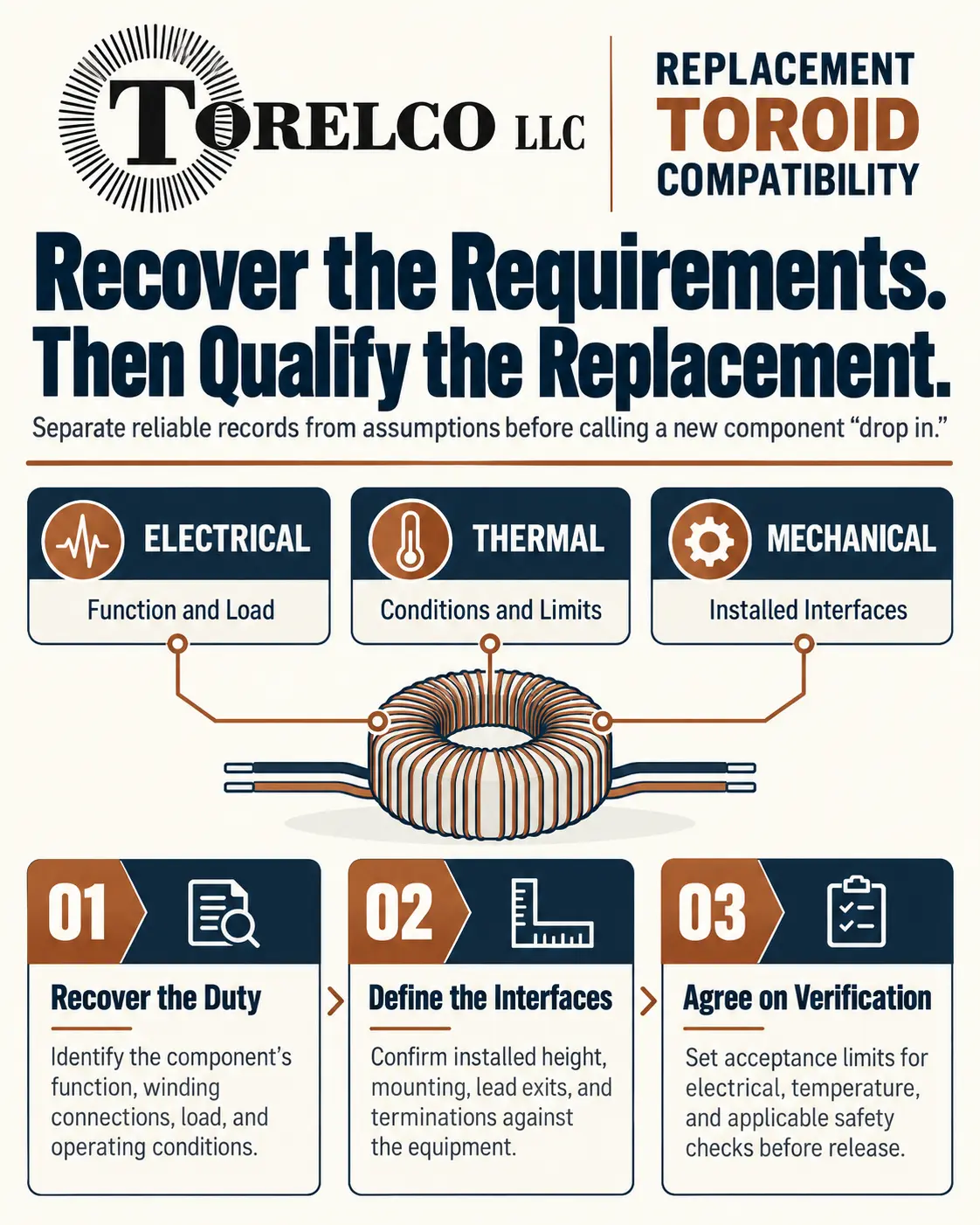
Start with the equipment documentation, not a list of dimensions alone. The relevant information depends on the component's function and the circuit around it. A responsible engineer should identify the required operating conditions and which characteristics control acceptance. This prevents a measurement taken from the old part from becoming an assumed design target without context.
Existing component | Information to recover |
Power transformer | Input voltage and frequency, winding connections, required outputs and the actual load conditions. |
Inductor or choke | Required inductance and measurement conditions, operating current, temperature limits and relevant resistance or saturation constraints. |
Either type | Available installation space, mounting, lead exits, terminations and the applicable equipment safety requirements. |
Incomplete or failed sample | Which observations remain reliable and which characteristics need confirmation from records, a known-good part or further evaluation. |
Nominal values need their conditions. An inductance reading does not by itself describe how an inductor performs at operating current and temperature. Likewise, an unloaded transformer output does not establish the output under the intended load. Keep measured observations, original specifications, and unresolved assumptions separate in the inquiry so we can review the proposed replacement against defined requirements.
Give Reverse Engineering a Usable Starting Point
When you ask us about reverse engineering, tell us whether the available component works, has failed, or has an unknown history. Don't treat a burned winding or damaged termination as the intended construction. The objective is to recover enough reliable information to propose and evaluate a replacement, not to promise an exact duplicate from appearance.
- Provide the equipment model, original part number, and available drawings or schematics. Include revisions and explain any modifications made since the equipment was supplied.
- Preserve labels, photographs, and connection records before disassembly. Discuss sample handling before sending the only available unit, including what information or inspection requires access to it.
- State the component's known electrical duty and how that information was obtained. Mark missing or estimated values so they do not silently become approved requirements.
- Describe the failure or reason for replacement. Include relevant service observations, while keeping the equipment fault investigation separate from assumptions about the component's design.
- Supply photographs and mechanical information showing mounting, lead exits, connectors, and nearby obstructions. Identify which interfaces must remain unchanged and where a redesign is possible.
- Identify who approves the proposed design and what verification is required. Ask about feasibility, sample needs, and documentation before setting a purchase deadline around an assumed replacement.
Define What Drop-In Must Actually Mean
A replacement described as drop-in should not require an installer to reinterpret the wiring or improvise its mounting. Confirm the dimensions that govern installation, including the installed height and space occupied by leads and terminations. Match the identified connections to the equipment documentation. If a connector, mounting arrangement, or winding connection must change, treat that as an engineering change rather than hiding it inside the replacement order.
For example, consider a proposed transformer with the required nominal outputs and an outside diameter that fits the enclosure. Its leads exit beside a panel where the original leads exited into open space. The part may fit on a bench but require an unsuitable bend or a changed harness when installed. A drawing that includes the surrounding assembly exposes that issue before the replacement is ordered. Electrical similarity does not resolve the mechanical interface.
Approve the Replacement in the Equipment Context
Agree on the verification plan before authorizing recurring production. Depending on the component and application, the plan may need to address connections, electrical performance under the intended load, temperature behavior, and insulation or safety requirements. The responsible engineer must select the applicable methods and acceptance limits. Testing an energized assembly requires qualified personnel and suitable equipment; an informal power-up does not fully qualify the assembly.
Also resolve why the original component failed. A replacement winding does not correct a fault elsewhere in the equipment. If the equipment has an existing approval or certification, determine how the proposed substitution affects it before release. Keep the accepted design, verification results, and installation information together so the next order refers to an approved configuration rather than starting the investigation again.
Missing drawings make recovering the equipment's operating and installation requirements the first task, not choosing a wire or matching a ring diameter. Agree what reverse engineering or sample evaluation must establish, then qualify the proposed replacement before releasing it for service. If the design still rests on an unresolved estimate, keep that condition visible rather than calling the part drop in. Send Torelco the available records, sample condition, and missing requirements to discuss a custom replacement or repair.