

How to Evaluate Toroid Coil Winding Before You Request a Quote
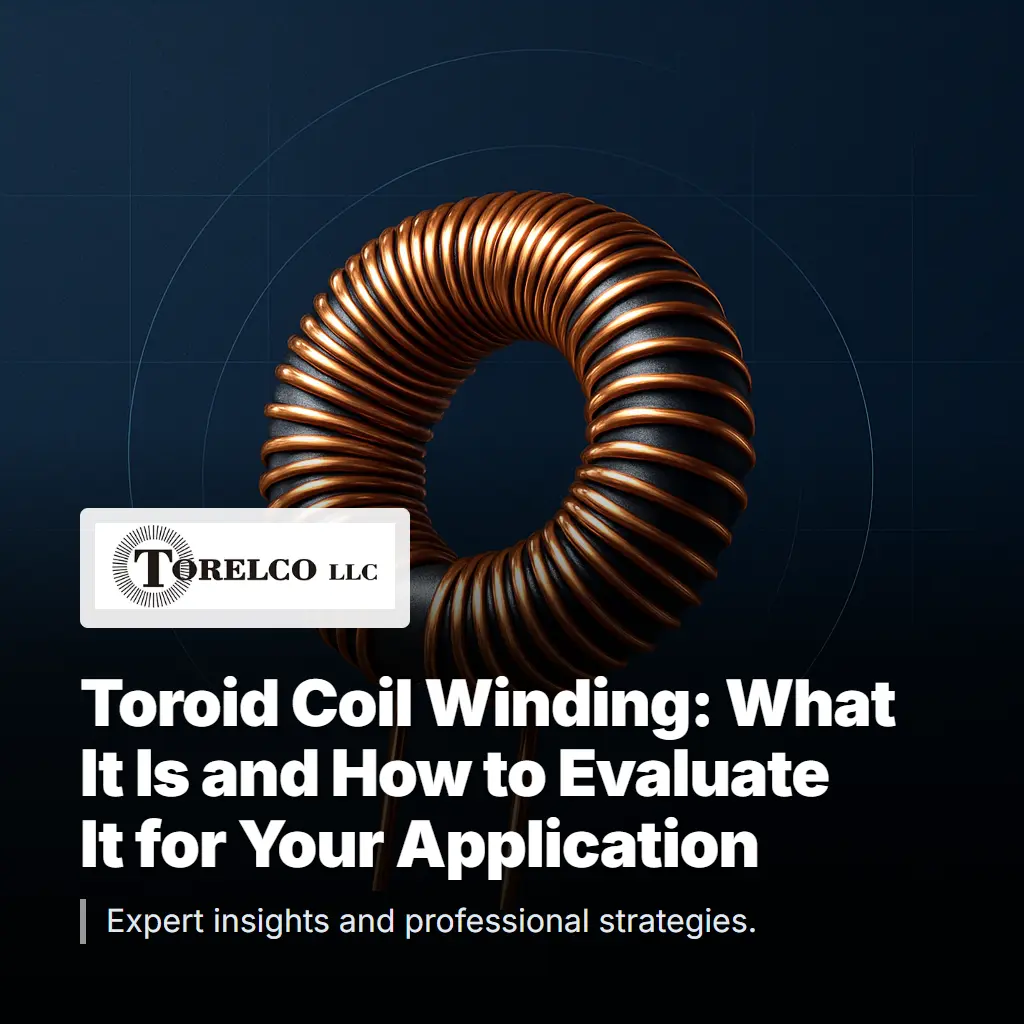
A toroidal core with the right material, size, and coating still becomes the wrong component when the winding details are vague. The risk often appears later, after the quote, during assembly, inspection, or production planning. A wound toroid that misses fit limits, creates lead-routing conflicts, or lacks clear acceptance criteria turns a sourcing request into a rework problem. That is why toroid coil winding should be evaluated as a finished component, not as a core-selection exercise.
A quote-ready request defines the electrical target, wire, turns, insulation, lead exit, finished dimensions, quantity, and inspection expectations before price comparisons begin. The goal is not to overdocument every possible detail. The goal is to give the supplier enough information to choose a winding method, judge repeatability, identify fit risks, and quote the same scope another supplier would quote.
Bare Core Vs. Finished Wound Toroid
Toroid coil winding applies controlled turns of wire around a closed toroidal core. Because the wire passes through the center window, winding access, fill, bend stress, spacing, and lead routing differ from bobbin or solenoid winding. A bare core defines the magnetic path and geometry, but the finished wound toroid defines the part that enters the assembly. That difference matters because sourcing a core and sourcing a wound component create different quoting and quality questions.
| Specification Area | Bare Toroidal Core | Finished Wound Toroid |
| Primary role | Provides magnetic path, basic shape, and core geometry. | Combines core, wire, turns, insulation, lead routing, and terminations into the usable component. |
| Key dimensions | OD, ID, height, coating, and finish. | Finished OD, height, window fill, lead-exit envelope, and mounting clearance. |
| Electrical result | Supports a design target. | Defines inductance, resistance, capacitance behavior, thermal performance, and inspection expectations. |
| Sourcing risk | Often quotable from material and dimensions. | Requires winding details to judge labor, repeatability, fit, and acceptance criteria. |
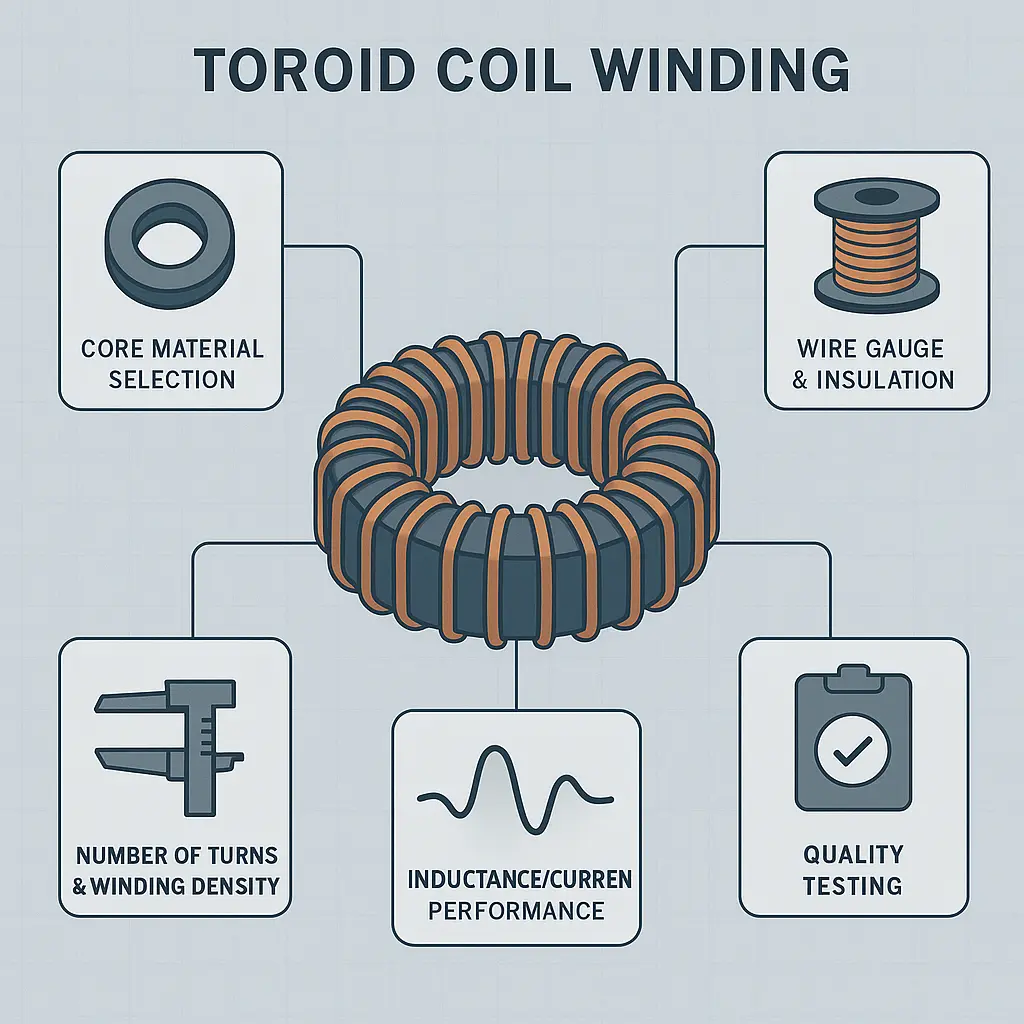
Core material affects magnetic behavior, but winding choices determine whether the part works in the assembly. The winding pattern, wire selection, insulation approach, lead exit, and termination method all shape the final component. A quote request that treats these as secondary details leaves too much room for supplier assumptions. It also makes price comparison unreliable because two quotes might include different work under the same part description.
- Core dimensions constrain window space and the finished component envelope.
- Wire gauge affects resistance, current capacity, bend stress, heat, and fill.
- Turns count drives inductance, winding labor, and repeatability requirements.
- Winding distribution affects consistency, capacitance behavior, and balance.
- Insulation protects voltage margin, material compatibility, and handling durability.
- Lead routing determines assembly fit, connection access, and rework risk.
- Termination method defines how the toroid connects to the next assembly.
The common mistake is assuming the correct core guarantees the desired coil. Winding execution changes inductance consistency, DC resistance, capacitance, insulation reliability, thermal behavior, physical fit, and production repeatability. That is why the evaluation should follow the finished part all the way into the application. A specification that stops at material and inductance leaves the most practical manufacturing questions unresolved.
Why Winding Details Change Risk
A request that states only core material and target inductance leaves the supplier to infer too much. The supplier has to judge winding method, labor, finished size, inspection scope, and lead time from incomplete information. A low quote might look attractive while excluding insulation work, termination preparation, inspection steps, or difficult lead routing. Comparable quotes require comparable winding scope.
Dense winding often supports compact packaging, but it reduces process margin. Tight packing increases handling difficulty, insulation concerns, and lead-routing risk. Small wire-placement variation might affect finished outside diameter, finished height, or window clearance. Lead length, exit location, and termination style also change labor, fit, and inspection requirements.
Lead routing deserves specific attention because it often creates problems outside the electrical design. A lead exiting from the wrong point might interfere with mounting hardware, enclosure clearance, nearby parts, or the next assembly step. A missing termination requirement might change stripping, tinning, sleeving, inspection, and delivery timing. These details are not cosmetic. They define the finished part.
What a Quote-Ready Toroid Winding Request Should Include
A toroid winding requirement is ready for evaluation when the supplier understands the core, electrical target, wire, winding pattern, mechanical envelope, leads, quantity, and acceptance criteria. Some unknowns might remain during early engineering review. Those unknowns should be marked clearly instead of hidden inside pricing assumptions. A better request gives the supplier enough detail to confirm what is buildable, repeatable, and inspectable.
| Requirement Area | Include in the Request | Supplier Should Confirm |
| Core information | Material, OD, ID, height, coating, finish, and handling limits. | Whether the core leaves enough window space for the winding. |
| Electrical information | Inductance, tolerance, current, resistance limit, frequency, and test condition. | Whether targets align with wire size, turns, and core space. |
| Wire information | Gauge, conductor type, insulation type, temperature rating, and substitution limits. | Whether the wire creates bend, fill, thermal, or sourcing concerns. |
| Winding information | Turns count, distribution, spacing, layer build, and coverage. | Whether the pattern is practical to wind and repeat. |
| Mechanical information | Maximum finished OD, height limit, window clearance, and mounting constraints. | Whether finished dimensions fit the package. |
| Lead and termination information | Exit location, length, stripping, tinning, sleeving, and termination method. | Whether routing creates interference, handling risk, or extra inspection work. |
| Commercial and quality information | Prototype or production quantity, delivery target, inspection expectations, and documentation. | Whether volume and inspection needs require a more repeatable method. |
Use one diagnostic question before quote comparison. Does the supplier have enough information to determine the winding method, finished outside diameter, lead exit location, insulation approach, and acceptance criteria from the information provided? If the answer is no, the request needs more detail. If the answer is partly, mark the open items for engineering or supplier review before treating the numbers as final.
When Manufacturability Review Is Needed
A toroid winding design is quote-ready when electrical, mechanical, insulation, lead, quantity, and acceptance needs are defined well enough to choose a winding method. Designs with tight fit, thermal rise concerns, insulation spacing requirements, high turn counts, unusual wire, or repeatable inductance needs should receive manufacturability review before final quote comparison. For custom toroids, this review helps align the electrical target, finished envelope, winding process, and lead routing before production assumptions become costly. It also separates design questions from purchasing questions, which makes the quote process cleaner.
Manufacturability review should focus on the part conditions that create the highest quoting or production risk. The review does not promise lower cost or shorter lead time. It confirms whether the winding is practical to build, repeat, inspect, and fit inside the stated limits. That is the information an engineer or buyer needs before comparing suppliers.
Review These Conditions Before Final Quote Comparison
- Inductance repeatability: clarify turns, distribution, tolerance, and test condition so acceptance criteria are measurable.
- Compact package: define wire gauge, winding density, finished OD, height, and clearance so the finished envelope is realistic.
- Thermal headroom: confirm wire size, current, resistance limit, and insulation rating so load conditions are not guessed.
- Insulation margin: define wire insulation, sleeving, layer insulation, and spacing where voltage or handling risk matters.
- Mechanical fit: define lead exit, length, termination, mounting clearance, and assembly orientation before routing becomes rework.
- Production repeatability: separate prototype expectations from production tolerances, inspection methods, quantity, and documentation needs.
Question low quotes that omit difficult details. Insulation, termination work, lead preparation, inspection criteria, and challenging routing change the real scope of a wound toroid. A cheaper quote that excludes those requirements is not the same quote. It is a different part definition.
Don’t Settle with Toroids
Evaluate the wound toroid, not just the toroidal core. A finished toroid depends on turns count, wire selection, winding distribution, insulation, terminations, lead routing, dimensions, operating conditions, quantity, and acceptance criteria. Each item affects whether the component performs electrically, fits mechanically, and stays repeatable in production. The quote should reflect the complete component, not only the easiest details to price.
Before requesting a quote, provide core data, electrical targets, turns count if known, wire specification, insulation requirements, finished size limits, lead and termination details, quantity, and inspection expectations. If a supplier lacks enough information to determine the winding method, finished dimensions, insulation approach, lead exit, and acceptance criteria from the request, the specification is not ready for quote comparison. A stronger request helps engineering and purchasing evaluate the same finished part. It also gives the supplier a clearer path to quote the work accurately.