

Toroid Transformer: When Does Potting Make Sense for a Harsh Installation?
A toroid transformer can pass electrical checks in a controlled setting and still be underprotected once installed in a demanding machine. Potting is often considered at that point, but it should not be treated as a universal improvement or a sign of a higher-grade transformer. Encapsulation is a packaging decision tied to exposure, handling, insulation strategy, mounting, and the finished assembly's protection of the component.
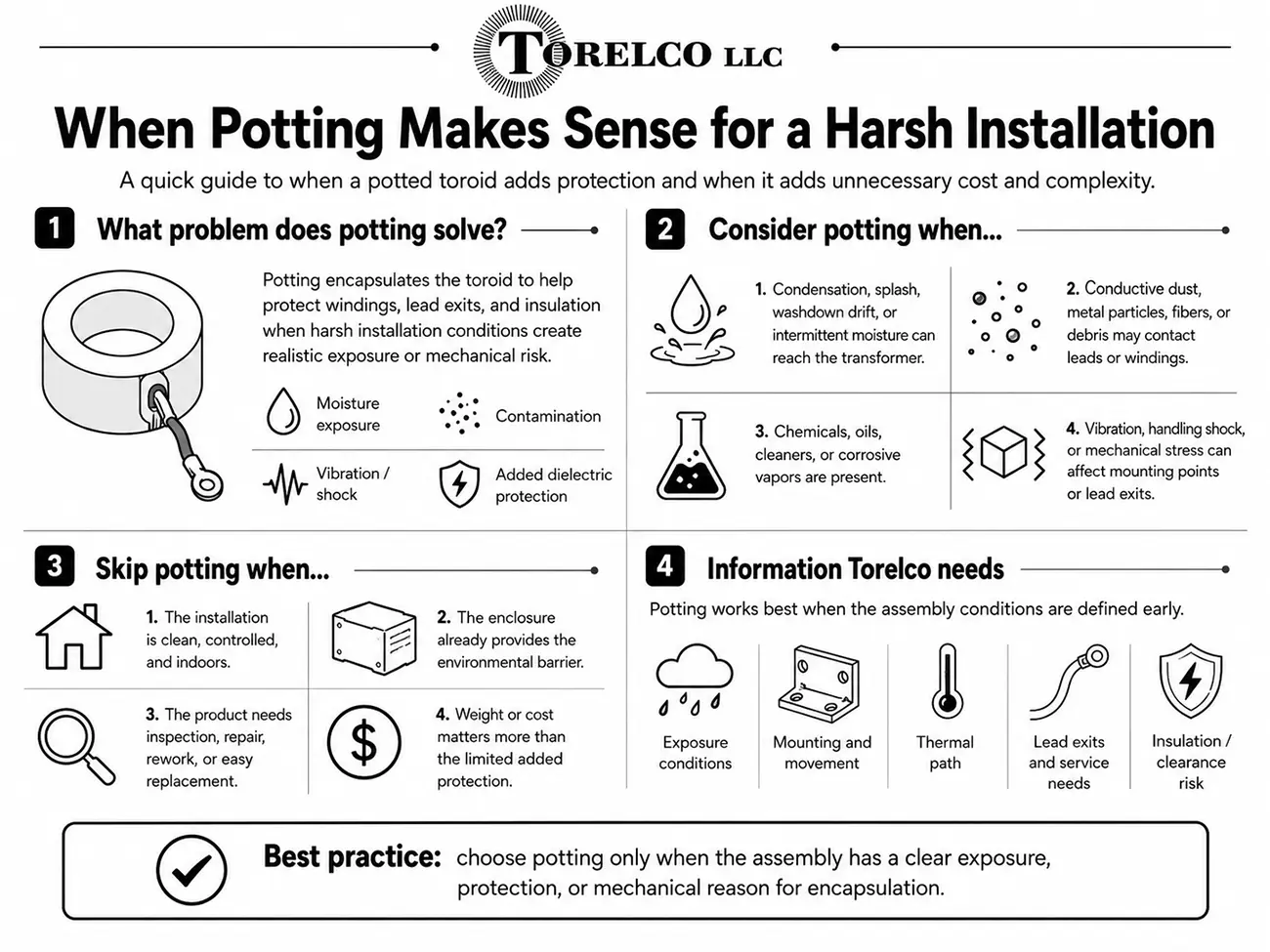
For harsh installations, potting makes sense when environmental or mechanical risks exceed what the transformer's base construction and equipment enclosure can reasonably manage. Moisture, conductive debris, chemical contamination, vibration, shock, and added dielectric protection can all justify encapsulation when those conditions are credible and recurring. The decision also has to account for serviceability, weight, cost, manufacturing complexity, and thermal behavior after the transformer is enclosed.
Installation Conditions That Make Potting Worth Considering
Potting becomes relevant when the transformer is placed where contaminants, movement, or stress can reach windings, terminations, insulation margins, or lead exits. A product enclosure may reduce exposure, but gaskets age, vents admit debris, cable entries create paths, and service panels may not be resealed consistently. In that type of installation, encapsulation can act as a secondary barrier rather than the only line of defense.
- Condensation cycles, splash exposure, washdown drift, or intermittent moisture inside the equipment envelope
- Conductive dust, metal particles, abrasive residue, airborne fibers, or contamination near leads and windings
- Oils, cleaners, chemical vapors, corrosive atmospheres, or process fluids that may contact transformer materials
- Repeated vibration, handling shock, mobile-equipment movement, or mechanical stress at the mounting interface
- Added dielectric protection where spacing, contamination, or assembly constraints increase insulation risk
The practical question is whether potting closes a realistic failure path. If moisture can migrate to lead exits, if debris can accumulate around insulation, or if vibration can fatigue connections, encapsulation may provide meaningful protection. If those risks are already controlled by the enclosure, mounting system, and product environment, potting may add little more than mass and cost.
Potting as an Assembly-level Packaging Decision
A potted toroid transformer should be evaluated as part of the finished assembly, not as a standalone component with a generic coating. The compound, case, fill level, lead arrangement, and mounting method all influence how the transformer behaves after installation. A design that appears robust on its own can still be mismatched if the resin traps service-critical parts, blocks needed clearances, or changes how the unit fits in the product.
Thermal behavior belongs in this same packaging review rather than as a separate justification for potting. Encapsulation changes the heat path between the windings, core, compound, case, mounting surface, and surrounding air. A compound may help conduct heat toward a housing in one design, while a sealed or poorly contacted assembly may create a less favorable heat path in another.
Packaging factor | Why it matters before potting |
Compound selection | Affects environmental resistance, rigidity, dielectric support, and heat transfer through the encapsulated mass. |
Case and mounting style | Determines how the transformer is supported, protected, and connected to the surrounding structure. |
Lead exit design | Influences strain relief, contamination resistance, assembly repeatability, and inspection access. |
Service expectations | Potting can make rework, replacement, and visual inspection difficult or impractical. |
Product enclosure | May already provide the primary environmental barrier, reducing the value of added encapsulation. |
This is why potting is strongest when the end-use conditions are known rather than assumed. A sealed industrial control system, mobile system, outdoor-adjacent device, or contamination-prone machine may warrant a more protective transformer package. A clean indoor assembly with stable mounting and limited exposure may be better served by a non-potted construction that preserves access and avoids unnecessary complexity.
When Potting Does Not Earn Its Place
Potting does not make sense simply because an installation sounds important or because the transformer is custom. In benign environments, a properly insulated and secured toroid can perform reliably without encapsulation. If the surrounding product already protects against user contact, contamination, and mechanical movement, the added process may not improve reliability enough to justify the tradeoffs.
The strongest reasons to avoid potting are usually practical rather than theoretical. Encapsulation adds material, labor, cure time, weight, and inspection constraints. It can also complicate field service because internal conditions are no longer visible and damaged assemblies may be replaced rather than repaired.
- Clean, controlled indoor equipment with limited environmental exposure
- Assemblies where the enclosure is already the qualified environmental barrier
- Products that require inspection, repair, rework, or periodic replacement
- Weight-sensitive devices where added compound mass affects the design
- Cost-sensitive applications where exposure risk does not support added processing
Compliance should also be addressed carefully during the finished assembly review. Standards and agency requirements may influence choices regarding insulation, enclosure, marking, testing, and evaluation, but they should be verified against the actual product configuration. They should not be treated as a blanket reason to pot every toroid, especially when exposure risk, service model, and thermal path do not support encapsulation.
The Right Time to Decide
The best time to decide on potting is before the transformer package is locked into the product design. At that stage, the installation environment, enclosure strategy, mounting method, insulation needs, lead routing, and service model can still be evaluated together. Late-stage potting decisions can solve one problem while creating another, especially when clearances, heat paths, or replacement procedures were not planned around encapsulation.
A potted toroid belongs in a finished assembly when environmental exposure, mechanical protection, insulation needs, and assembly-level packaging justify the added material and permanence. It is not a default upgrade, nor a substitute for understanding the actual installation. Torelco can support that evaluation by helping align potting, encapsulation, or non-potted construction with the conditions the toroid transformer will actually face.