

Toroids: When Does a Tap Make More Sense Than a Single-output Winding?
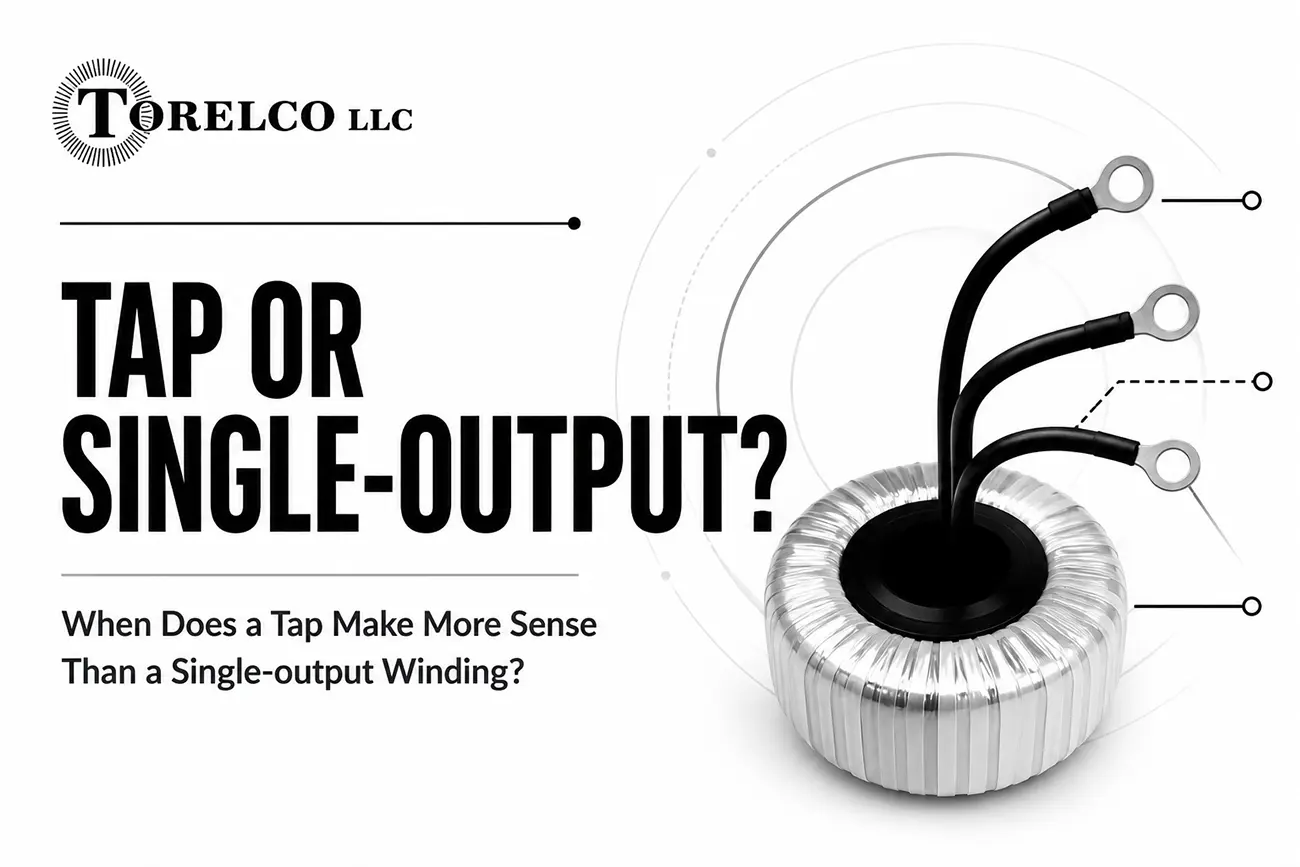
A winding tap can look like a small detail on a drawing, but in production, it changes how a toroidal transformer behaves, how it connects, and how it is evaluated within the finished assembly. It is not simply one more lead added for convenience. On toroids, that intermediate point has to be planned into the winding pattern, lead exit, insulation approach, termination layout, and intended load condition.
For custom toroids, a tapped winding makes the most sense when one transformer needs selectable output conditions, a defined intermediate voltage, or a practical way to serve related circuit requirements from the same winding structure. It should not be treated as a standard upgrade for every single-output winding, because the better solution may still be a dedicated secondary, a different turns ratio, or a cleaner single-output design. Torelco approaches tapping as an application-driven winding decision rather than a generic feature.
What a Tap Does in a Toroid Winding
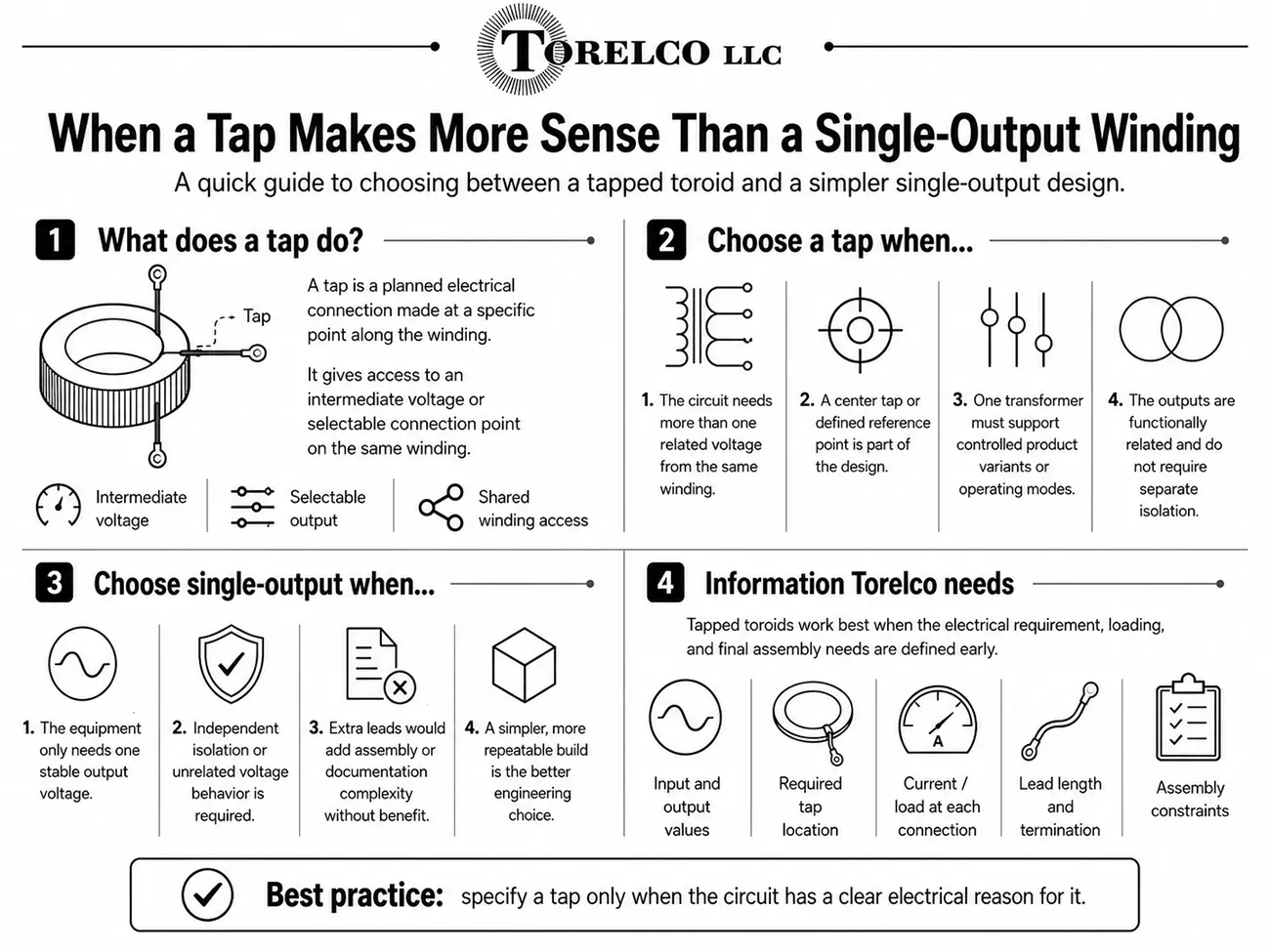
A tap is a deliberately placed electrical connection along a winding, not an afterthought added wherever a lead happens to be convenient. In toroids, that connection provides the circuit with access to a calculated portion of the turns, allowing the same winding to support a defined voltage point, a selectable input or output condition, or a shared reference arrangement. The tap belongs to the winding design from the start because its location affects lead routing, termination, labeling, test expectations, and final assembly behavior.
Winding approach | What it provides | When it may fit |
Single-output winding | One intended output across the full winding | Equipment needs one fixed voltage point |
Tapped winding | Access to part of the winding as well as the full winding | Equipment needs selectable or defined intermediate points |
Separate winding | Electrically distinct output path | Loads need stronger separation or independent behavior |
A tapped winding can reduce the need for an entirely separate winding when the application only needs access to a specific fraction of the same turns. For example, a secondary may be designed so equipment can use the full secondary voltage in one operating mode and a lower voltage from the tap in another. That does not mean both points can always be loaded as independent outputs, because current, heating, regulation, and total VA expectations still have to be evaluated as one coordinated design.
That planning is what separates a useful tap from an unnecessary complication. A tap can simplify wiring, support product variants, or enable a single transformer to serve a controlled set of operating conditions. It can also add lead management and documentation requirements that a plain single-output winding would avoid.
When a Tap Makes More Sense Than a Single-output Winding
A tap makes sense when equipment needs access to more than one electrical point on the same winding, rather than to a completely isolated secondary. In practical terms, that can mean a toroid must provide a lower-voltage option, a center reference, or a selectable connection that allows the same transformer to support more than one operating condition. The key distinction is intentionality: the tap should correspond to a defined circuit requirement, not a “just in case” feature added without a load, wiring, or service rationale.
- Selectable voltage outputs for related configurations
- Intermediate winding access for a control or reference point
- Center-tap requirements where the circuit is designed around symmetry
- Product families that need one transformer design to support controlled variants
A tapped winding is often appropriate when the outputs are functionally related and the design benefits from keeping them on the same winding structure. Equipment may need a nominal output plus a reduced-voltage option for a specific mode, region, or accessory. In that case, a tap can reduce the need for multiple separate transformer versions, provided the loading and lead arrangement are clearly documented.
The decision becomes less favorable when the outputs need independent isolation, unrelated voltage behavior, or simultaneous loading that separate windings would better handle. A tap does not turn one winding into multiple independent supplies; it simply creates additional connection points along that winding. That is why a tapped toroid should be specified around the circuit requirement first, then the winding layout, lead identification, and production repeatability.
When a Single-output Winding Is the Better Choice
A single-output winding is usually the better choice when equipment requires a single stable voltage and no intermediate connection point. In that case, adding a tap can create additional lead-management, documentation, and assembly decisions without improving the finished product. The simpler winding is easier to specify, easier to identify during installation, and less likely to invite incorrect field connections.
This matters because taps are sometimes requested as a reserve option rather than a defined electrical requirement. Tapping should not be treated as a harmless universal upgrade. The effect of a tap depends on how the winding is used, what load is connected, and whether the tap is selected or loaded at the same time as other winding points. If an application only calls for one output, the cleaner engineering path is often to avoid unused connection points altogether. A dedicated single-output winding can keep the build more direct, repeatable, and easier to document.
The distinction is especially important in production environments where consistency matters as much as flexibility. A fixed-output toroid can simplify wiring instructions, reduce the number of terminated leads, and make repeat builds more straightforward. It also helps purchasing and engineering teams avoid paying for a custom feature that never supports the circuit.
Information Torelco Needs for a Tapped Toroid
A tap earns its place on toroids only when the design requires defined intermediate access points, alternative connection options, or selectable output conditions that a single-output winding cannot cleanly provide. When those needs are real, the winding plan has to account for voltage targets, current loading at each lead combination, termination style, labeling, and how the assembler or end user will make the connections. Engineering teams can provide required input values, output values, tap locations, load profile, lead lengths, and assembly constraints so Torelco can translate the requirement into a practical custom winding approach.