

Are Toroidal Transformers Greener Than Conventional Laminated Transformers?
Toroidal transformers can offer environmental advantages over conventional E-I laminated transformers, particularly through lower electrical losses, reduced material requirements, and more compact construction. However, their circular design does not automatically make them the greener choice. The actual benefit depends on how efficiently the transformer operates, the materials used to manufacture it, and whether its design reduces environmental impacts elsewhere in the finished equipment.
At Torelco, we manufacture custom toroidal transformers and E-I laminated magnetic components for equipment manufacturers with specific electrical and mechanical requirements. Both designs can serve demanding applications, and neither should be considered environmentally preferable based on its shape alone. Understanding where toroidal construction creates genuine advantages, and where common environmental claims go too far, provides a more useful basis for comparing the two.
How Toroidal Transformers Can Reduce Energy Waste
One of the strongest environmental arguments for toroidal transformers is their potential to operate with lower electrical losses. Conventional E-I transformers use separate steel laminations, while toroidal cores typically form a continuous magnetic path from a strip of wound electrical steel. Combined with an appropriate winding arrangement, this construction can provide favorable magnetic coupling and reduce certain losses. However, efficiency also depends on the core material, winding resistance, operating frequency, and electrical loading.
NASA examined these relationships in its technical memorandum, Design of Toroidal Transformers for Maximum Efficiency. The analysis demonstrates how transformer geometry, magnetic flux density, materials, and winding characteristics affect efficiency. Its central finding is that even among toroidal designs, the balance between copper and core losses changes with the selected dimensions and construction. This supports the environmental argument without suggesting that every toroidal transformer necessarily outperforms an equivalent laminated design.
The environmental benefit becomes more significant when electrical losses accumulate during operation. A transformer consumes some electricity whenever it remains energized, and additional losses occur as it supplies current to connected equipment. A 2026 systematic review published in The International Journal of Life Cycle Assessment examined 15 transformer lifecycle studies and found that operating losses accounted for approximately 90% to 99% of assessed environmental impacts in several of them. Those findings primarily concern larger power and distribution transformers, so the percentages don't apply directly to Torelco's custom components. Nevertheless, the research establishes why electricity wasted during operation belongs in any serious environmental comparison. A transformer that demonstrably reduces those losses under comparable conditions can provide an energy-saving advantage over its operating life.
Can Toroidal Transformers Reduce Material Consumption?
Toroidal construction can sometimes achieve the required electrical performance with less copper and magnetic steel than a comparable E-I design. When that happens, the advantage extends beyond the transformer's size or weight. Using less material can reduce manufacturing resources, including metal extraction, processing, and transportation. The savings depend on the transformer rating, core material, winding configuration, and operating requirements.
The 2026 lifecycle review identifies electrical steel and winding metals as important manufacturing inputs, supporting the relevance of material consumption to environmental assessments. However, the researchers also found substantial differences in how transformer studies accounted for manufacturing and operating impacts. Their findings reinforce an important distinction: reducing the amount of copper or steel may improve the manufacturing footprint, but it does not establish a lower overall environmental impact if the resulting design consumes more electricity during operation.
A smaller transformer may also allow equipment manufacturers to reduce enclosure dimensions, mounting hardware, or other supporting materials. Those secondary savings are possible only when the finished equipment can actually take advantage of the smaller component. If an enclosure must remain the same size to accommodate wiring, ventilation, or other equipment, the transformer does not automatically create additional material savings. The environmental advantage depends on what changes in the finished product, not simply what changes in the transformer.
Does Cooler Operation Make a Transformer Greener?
Electrical losses produce heat, so a transformer with lower losses under the same operating conditions generates less waste heat. This can reduce the thermal load within an equipment enclosure and, in some applications, lower the need for additional cooling. However, cooler surface temperatures do not automatically establish higher efficiency. Transformer size, airflow, mounting, loading, and enclosure conditions all influence how heat moves through the component and into its surroundings.
A 2020 study published in the Journal of Advanced Thermal Science Research examined temperature behavior in a 2 kVA toroidal transformer. Researcher Adrian Pleșca developed and experimentally validated a thermal model that considered transformer geometry, electrical current, and ambient temperature. The study showed how operating conditions affect maximum transformer temperature, reinforcing that thermal performance cannot be judged by construction type alone. For equipment manufacturers, the environmental benefit comes from reducing wasted energy and resulting cooling requirements, not simply selecting the transformer with the lowest surface temperature.
This distinction also applies to compact installations. A smaller toroidal transformer may fit into a restricted enclosure, but limited ventilation can still produce elevated operating temperatures. Likewise, a larger transformer with more effective heat dissipation may feel cooler without necessarily generating less waste heat. The meaningful comparison is the energy lost and the thermal requirements of the finished equipment.
Common Myths About the Environmental Benefits of Toroidal Transformers
Many environmental claims about toroidal transformers originate from genuine characteristics of their construction. Problems arise when potential advantages are presented as universal guarantees or when one favorable specification is used to imply a lower overall environmental footprint. Several common assumptions deserve closer examination.
- Smaller automatically means greener. Compact dimensions can reduce material use, but a smaller transformer is not necessarily more efficient. Its actual losses and operating conditions determine whether the design delivers an environmental advantage.
- Lighter transformers always have a lower environmental impact. Less copper and steel can reduce manufacturing requirements, but you must consider weight reduction alongside electrical efficiency and the transformer's expected operating conditions.
- A cooler transformer must be more energy-efficient. Surface temperature depends on heat transfer, ventilation, and electrical losses. A cooler exterior does not independently establish lower energy consumption.
- Toroidal transformers eliminate harmful manufacturing treatments. Some toroidal constructions may require less vibration control, but varnishing, impregnation, and encapsulation are not universally unnecessary. Torelco offers these processes where the component's application and construction requirements justify them.
- Lower shipping weight guarantees lower total emissions. Reduced weight can affect transportation requirements, but shipping distance, transportation method, packaging, and operational energy consumption also influence the environmental footprint.
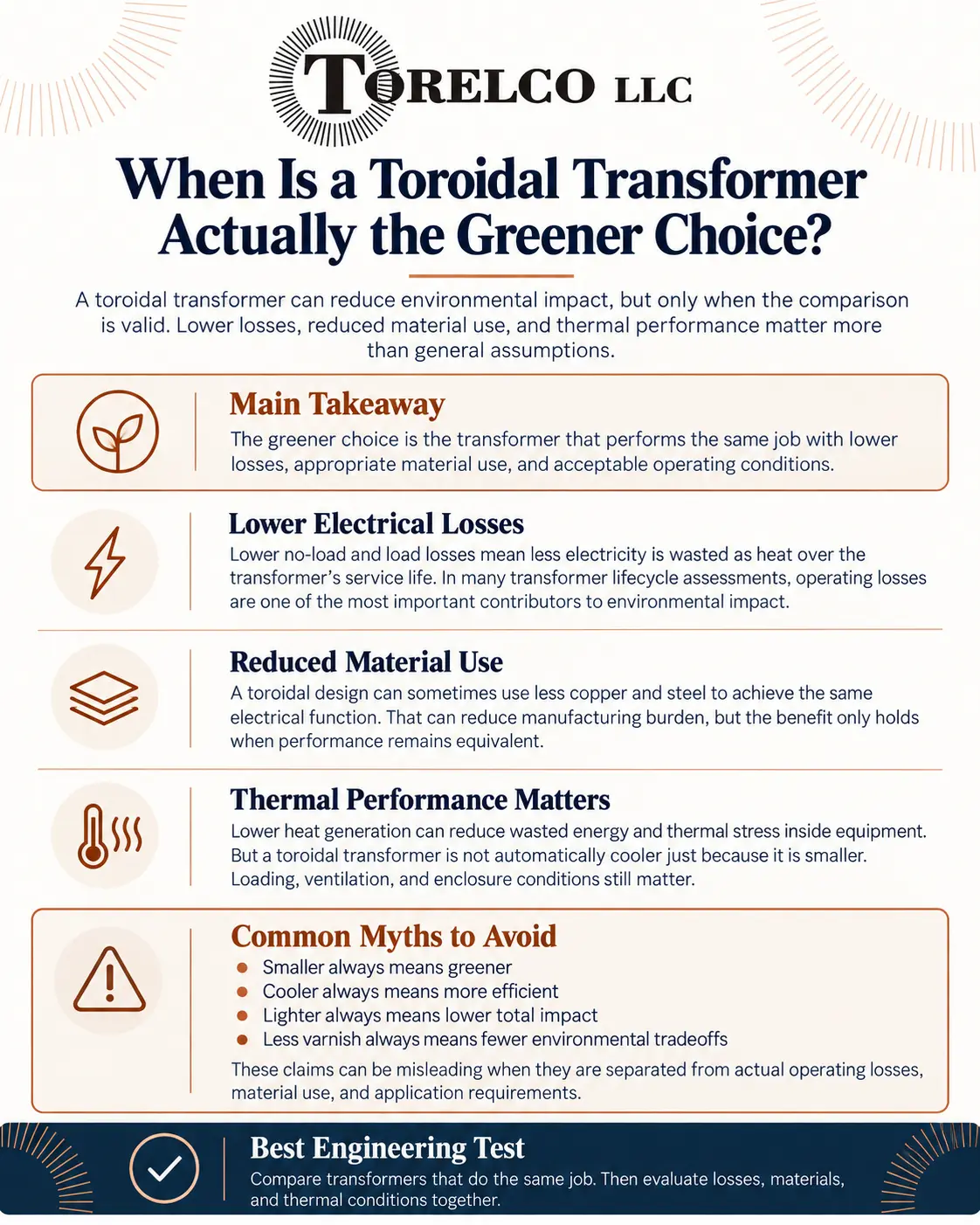
These misconceptions share a common weakness: they isolate one design characteristic without considering the complete environmental tradeoff. A transformer may require fewer raw materials while producing greater electrical losses, or occupy less space without reducing the surrounding enclosure. Conversely, a design that reduces both material requirements and operating losses offers a stronger environmental case. The most credible claims are therefore based on comparable performance and actual construction requirements rather than broad assumptions about transformer geometry.
When Is a Toroidal Transformer the Greener Choice?
Toroidal transformers can be the environmentally preferable option when their design reduces electrical losses, material consumption, or supporting equipment requirements compared with an equivalent laminated transformer. Those advantages matter only if they don't introduce offsetting disadvantages elsewhere in the finished assembly. An E-I laminated design may remain appropriate when it better satisfies the complete application requirements, particularly where the proposed toroidal alternative cannot demonstrate a meaningful environmental improvement.
At Torelco, we manufacture custom toroidal transformers, E-I laminated magnetic components, and related winding solutions for commercial equipment applications. Manufacturers evaluating a new transformer design or an alternative to an existing component can contact Torelco to discuss their electrical and mechanical requirements. The right design begins with the application, and any environmental advantage should follow from how that transformer actually performs.