

Are Toroids Worth Redesigning Your Enclosure For?
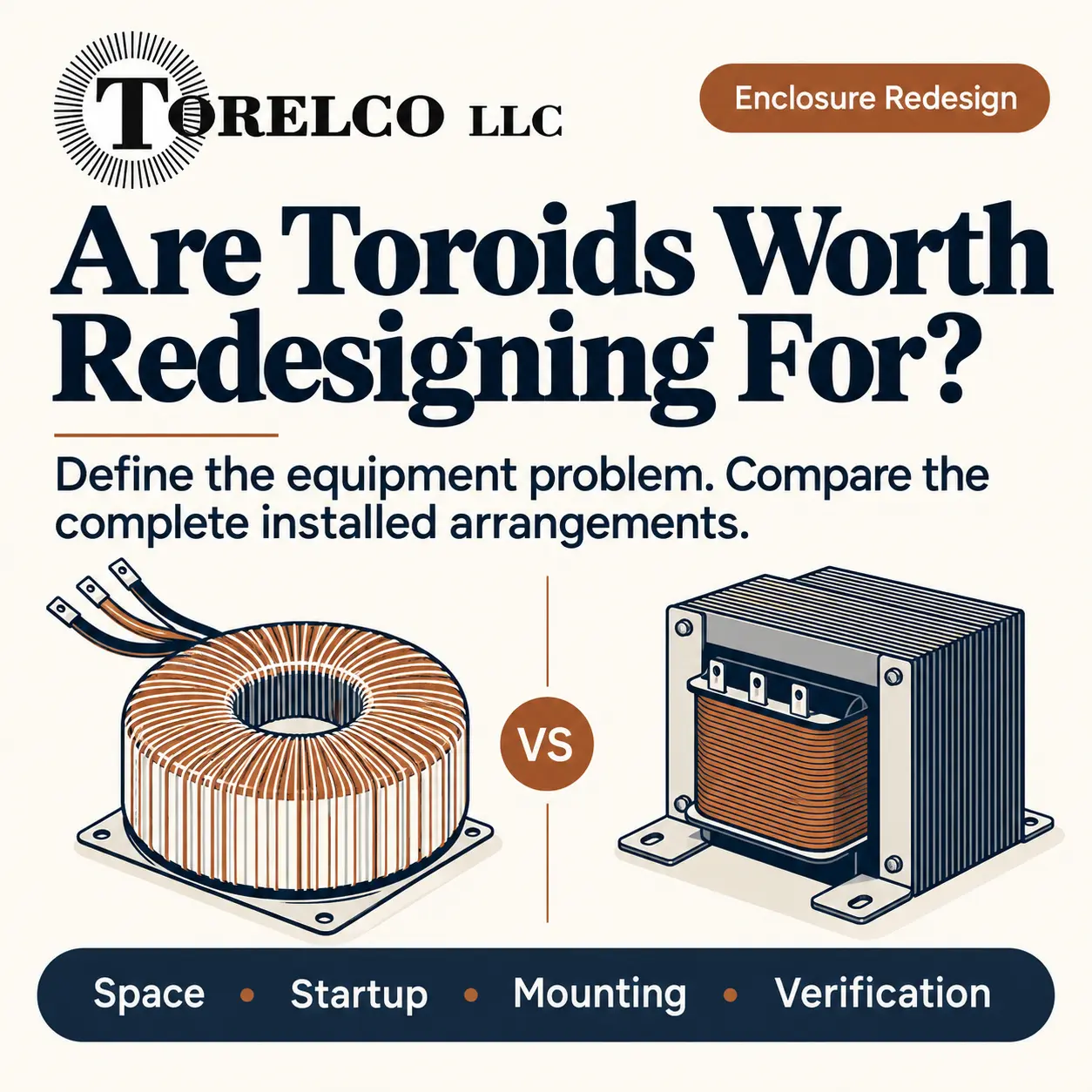
Changing from an E-I transformer to a toroidal transformer is worthwhile when it solves a defined equipment problem. It isn't automatically an upgrade just because the new component is round, shorter, or described as quieter. At Torelco, we wind toroids and produce E-I laminated and other wound components to customer specifications. That gives the discussion a useful starting point: what must improve in your equipment, and what must remain unchanged?
Identify the constraint before comparing quotations. You may need more vertical space, a different mounting arrangement, or less magnetic coupling into nearby circuitry. Record the existing transformer's installed dimensions and operating requirements, then define the improvement that would justify a change. Without that baseline, a promising component can trigger a redesign without delivering the intended benefit.
Compare Complete Arrangements Rather Than Core Shapes
Toroidal construction can offer a compact package and a low external magnetic field, but the result depends on the selected design and application. No universal size or noise reduction applies to every conversion. Compare a specified toroidal design with the actual E-I arrangement at the required electrical duty. Include the mounting and wiring, not just the dimensions on the component drawing.
Design constraint | Comparison that matters |
Enclosure space | Installed height and footprint including mounting, leads, insulation and service access. |
Nearby sensitive circuitry | Performance in the intended layout under relevant operating conditions, not a generic magnetic-field claim. |
Electrical supply | Required outputs and load behavior, startup demands and the existing protection arrangement. |
Production and service | Assembly changes, wiring identification, installation instructions and replacement access. |
Project cost | Component quotation plus mounting, harness changes, verification and any required approval review. |
Check Where the Apparent Space Saving Goes
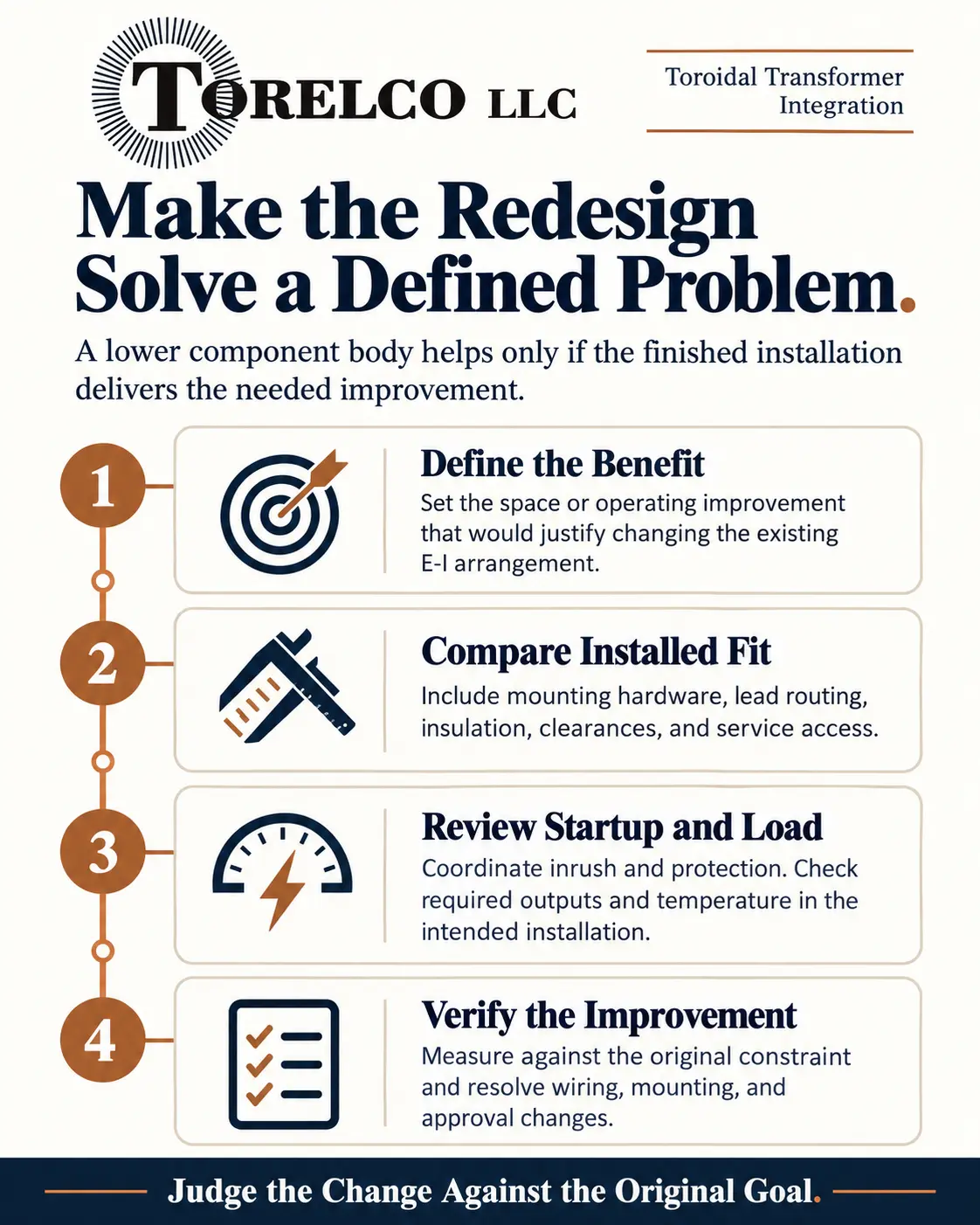
Place the proposed component and its mounting hardware into the assembly drawing. Allow for lead exits, connectors, surrounding components, and fastener access. A smaller body may help, but it does not prove the installed arrangement is smaller. The design also needs appropriate insulation and clearances, as determined by the equipment's responsible engineer and applicable requirements.
Consider an enclosure that needs additional clearance beneath its lid. A proposed toroidal transformer has a lower body than the existing E-I component, but its fixing arrangement and lead routing occupy part of the saved space. The team should compare the complete installed stack against the required lid clearance. If it still provides the needed room and can be serviced properly, the change has a measurable benefit. If it does not, a lower component height alone is a weak reason to redesign.
Mounting also has an electrical consequence. A conductive loop that passes through the center of a toroidal transformer and closes around it can act as a shorted turn. One hazardous arrangement allows both ends of a central fixing bolt to contact a surrounding metal frame. Follow the selected design's mounting instructions and have the installation reviewed; do not improvise a bracket simply because the bolt holes align.
Review Operation From Startup Through Normal Load
The transformer must work with the actual supply, load, and enclosure. Check the proposed arrangement at the conditions that matter to the equipment rather than carrying over every decision from the old design. The verification plan should identify the responsible engineer, required checks, and acceptance limits before describing a prototype result as successful.
- Review startup behavior with the intended supply and protection. Transformer inrush may affect operation, so any protection or soft-start change needs engineering coordination. Do not increase a fuse rating merely to stop nuisance trips.
- Check required outputs under the relevant loads. An unloaded voltage reading does not reflect loaded performance, and load type matters when specifying the transformer.
- Evaluate temperature in the intended installation. Ambient conditions, enclosure ventilation and mounting can affect the thermal result; an open-bench check is not automatically representative of the finished product.
- Separate acoustic noise from electrical interference. A hum heard at the enclosure and a disturbance measured in a signal circuit are different observations and may require different investigations.
- Record changes to wiring, mounting, and documentation. If existing equipment approvals apply, determine what review or testing the substitution requires rather than assuming approval transfers with the component.
Judge the Change Against the Problem it Was Meant to Solve
Return to the original constraint after evaluating the proposed arrangement. If the objective was lid clearance, compare the verified installed dimensions. If it was interference with a sensitive circuit, compare the relevant measurements in the intended layout. Do not replace that decision with a general statement that toroids are more efficient or more precise. You cannot meaningfully accept a benefit that has not been defined.
Include implementation effort in the commercial comparison. A component quotation does not cover all costs of a changed bracket, harness, installation, instructions, or approval review. Retaining a satisfactory E-I arrangement can be the better decision when the proposed toroid does not solve a meaningful constraint. Conversely, a verified improvement in the required space or operating behavior can justify those changes when the rest of the design remains acceptable.
Send Torelco your electrical requirements, available installation space, mounting constraints, and the specific improvement you need. We can discuss custom winding options against that information. The decision should follow a defined comparison of the two installed arrangements, with the proposed benefit and the required verification clear before you commit the equipment to a redesign.